
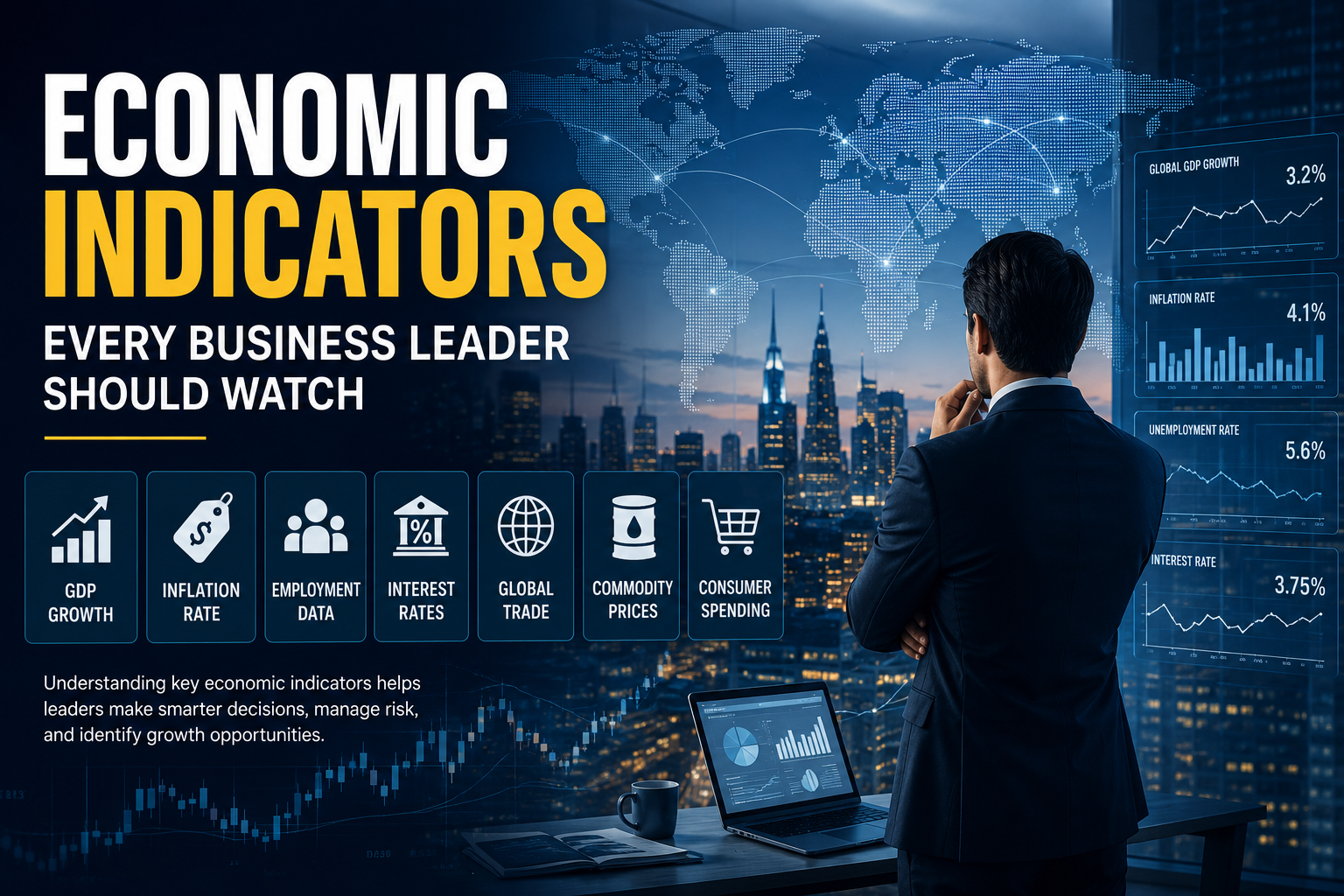
Learn which Economic Indicators help business leaders monitor market conditions, manage risk, and make informed strategic decisions.
Economic Indicators Every Business Leader Should Watch
Successful businesses do not rely solely on internal performance metrics. They also pay close attention to the broader economy to anticipate opportunities and prepare for potential challenges. Economic Indicators provide valuable insights into market conditions, helping business leaders make informed decisions about investments, hiring, pricing, and long-term planning.
Understanding these indicators enables organizations to respond proactively to changing economic environments rather than reacting after significant changes have occurred.
What Are Economic Indicators?
Economic Indicators are statistical measurements that reflect the health and direction of an economy. Governments, financial institutions, and economists use these indicators to evaluate economic performance and forecast future trends.
Businesses use economic indicators to:
- Monitor market conditions
- Assess business risks
- Plan investments
- Forecast customer demand
- Support strategic decision-making
Tracking these metrics regularly helps organizations remain adaptable in changing economic conditions.
Why Economic Indicators Matter
Economic conditions influence consumer spending, business investment, employment, and financial markets. Monitoring Economic Indicators allows leaders to identify trends that may affect operations and profitability.
The benefits include:
- Better strategic planning
- Improved financial forecasting
- Stronger risk management
- More informed investment decisions
- Enhanced budgeting accuracy
- Greater business resilience
Businesses that understand the economic environment are often better prepared for uncertainty.
Gross Domestic Product (GDP)
Gross Domestic Product (GDP) measures the total value of goods and services produced within an economy over a specific period.
GDP growth often indicates:
- Expanding economic activity
- Increased business opportunities
- Higher consumer spending
- Greater investment confidence
Conversely, slowing or declining GDP may signal weaker economic conditions that require more cautious business planning.
Inflation
Inflation measures the rate at which prices for goods and services increase over time.
Rising inflation can affect businesses by:
- Increasing operating costs
- Reducing consumer purchasing power
- Influencing pricing strategies
- Affecting profit margins
Monitoring inflation helps businesses adjust budgets and pricing to maintain financial stability.
Interest Rates
Interest rates significantly influence borrowing costs for businesses and consumers. Central banks often adjust rates to manage inflation and support economic stability.
Changes in interest rates may impact:
- Business loans
- Mortgage demand
- Consumer spending
- Investment decisions
- Corporate expansion plans
Understanding interest rate trends supports better financial planning.
Unemployment Rate
The unemployment rate reflects the percentage of people actively seeking work but unable to find employment.
This Economic Indicator provides insights into:
- Labor market conditions
- Consumer confidence
- Wage pressures
- Hiring availability
A low unemployment rate may indicate a strong economy, while higher unemployment may reduce consumer spending.
Consumer Confidence
Consumer confidence measures how optimistic consumers feel about the economy and their financial situation.
Higher confidence often leads to:
- Increased retail spending
- Greater demand for products and services
- Business expansion opportunities
Lower confidence may encourage consumers to reduce discretionary spending, affecting sales across multiple industries.
Business Confidence
Business confidence reflects how optimistic companies are about future economic conditions and growth opportunities.
High confidence can encourage:
- Capital investment
- Business expansion
- New hiring
- Product development
Monitoring business sentiment provides additional insight into future market activity.
Stock Market Performance
Financial markets often respond quickly to changing economic conditions. Although stock market performance does not represent the entire economy, it can provide valuable signals about investor expectations and business sentiment.
Business leaders monitor market performance to:
- Evaluate investment conditions
- Assess economic outlook
- Understand industry trends
- Identify potential risks
Stock market trends should be considered alongside other economic indicators rather than in isolation.
Using Economic Indicators for Business Planning
No single indicator tells the complete story of an economy. Effective business leaders evaluate multiple Economic Indicators together to gain a balanced understanding of market conditions.
Organizations can use this information to:
- Develop growth strategies
- Adjust pricing models
- Plan workforce needs
- Manage financial risks
- Identify expansion opportunities
Regular economic analysis supports more confident and informed decision-making.
Conclusion
Economic Indicators provide essential insights into the health of the economy and the factors that influence business performance. By monitoring measures such as GDP, inflation, interest rates, unemployment, consumer confidence, and financial markets, business leaders can better anticipate change and respond strategically.
Organizations that incorporate economic analysis into their planning processes are better equipped to manage uncertainty, seize new opportunities, and achieve sustainable long-term success.
