
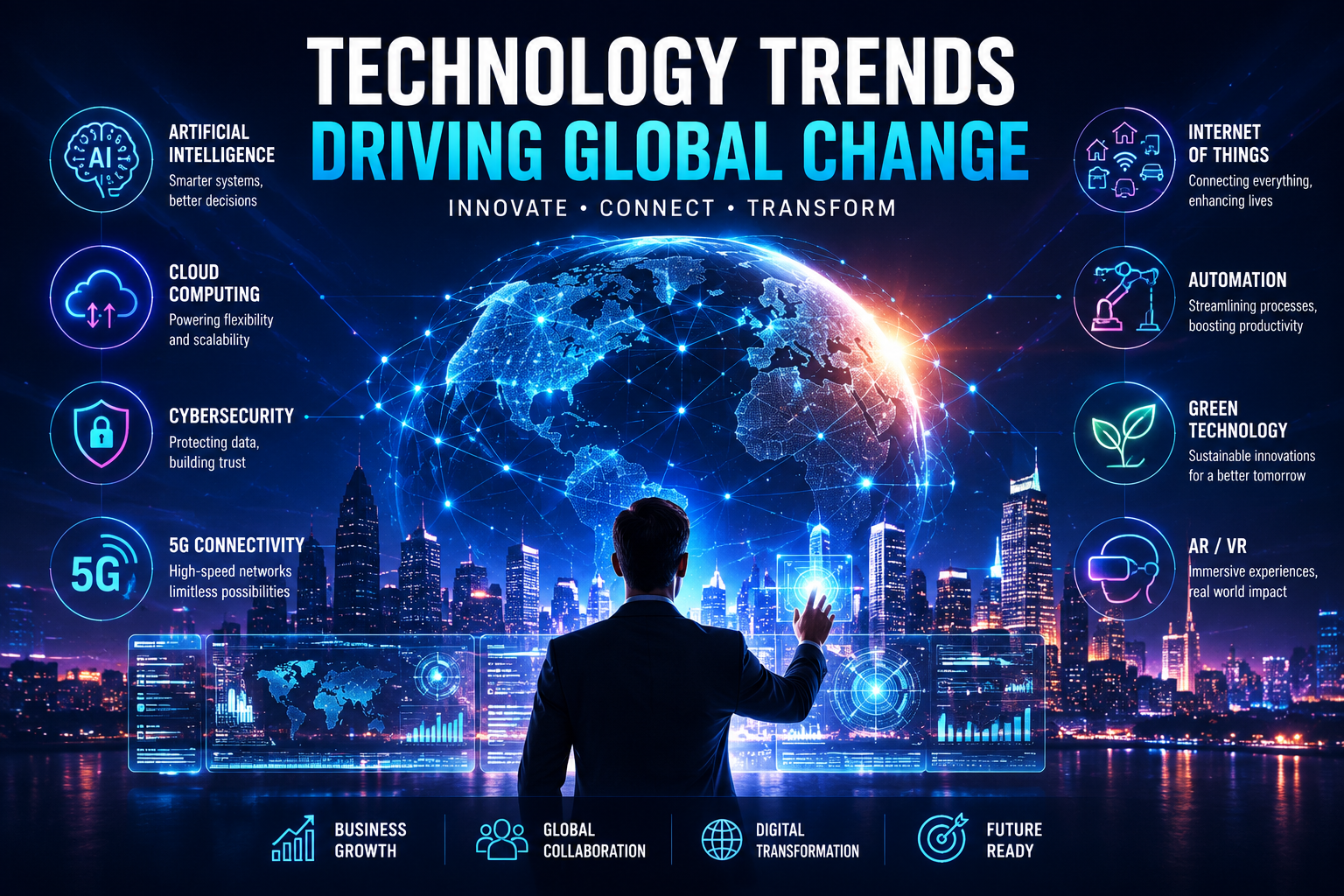
Discover the latest Technology Trends driving global change through artificial intelligence, automation, cloud computing, blockchain, and digital innovation.
Technology Trends Driving Global Change
Technology continues to reshape industries, economies, and everyday life at an unprecedented pace. Businesses, governments, and individuals are adopting new digital solutions to improve efficiency, increase productivity, and solve complex challenges. Understanding current Technology Trends helps organizations prepare for the future while remaining competitive in a rapidly evolving global marketplace.
From artificial intelligence to advanced connectivity, technological innovation is transforming how the world works.
Artificial Intelligence Becomes Mainstream
Artificial intelligence (AI) is one of the most influential Technology Trends shaping global change. Businesses use AI to automate repetitive tasks, analyze data, improve customer service, and support strategic decision-making.
AI-powered tools are also helping healthcare providers, financial institutions, manufacturers, and retailers improve efficiency while delivering more personalized services.
Automation Improves Productivity
Automation continues to transform industries by reducing manual work and increasing operational efficiency. Organizations automate manufacturing processes, administrative tasks, customer support, inventory management, and marketing campaigns.
Automation enables employees to focus on innovation, creativity, and higher-value responsibilities that contribute to business growth.
Cloud Computing Supports Digital Transformation
Cloud computing allows businesses to access software, data, and computing resources over the internet. Cloud-based systems improve collaboration, reduce infrastructure costs, and provide flexibility for organizations operating across multiple locations.
Businesses using cloud technology can scale operations more efficiently while supporting remote and hybrid work environments.
Internet of Things Connects Smart Devices
The Internet of Things (IoT) enables devices, sensors, and machines to communicate and exchange data in real time. Smart factories, connected vehicles, healthcare equipment, and intelligent buildings all benefit from IoT technology.
Real-time monitoring improves operational efficiency, predictive maintenance, and resource management across many industries.
Cybersecurity Continues to Evolve
As digital technologies become more widespread, cybersecurity remains one of the most critical Technology Trends. Businesses invest in advanced threat detection, multi-factor authentication, encryption, and artificial intelligence-powered security systems to protect sensitive information.
Strong cybersecurity helps organizations maintain customer trust while reducing operational risks.
Blockchain Expands Beyond Cryptocurrency
Blockchain technology is increasingly used in supply chain management, healthcare, financial services, digital identity verification, and contract management. Its decentralized structure improves transparency, security, and data integrity.
Businesses are exploring blockchain to streamline transactions and strengthen trust between organizations and customers.
Robotics Transforms Operations
Modern robotics improves productivity by performing repetitive, dangerous, and highly precise tasks. Manufacturing, healthcare, agriculture, warehousing, and logistics industries continue expanding their use of robotic systems.
Advances in robotics support greater efficiency while improving workplace safety.
5G Enables Faster Connectivity
The global expansion of 5G networks provides faster internet speeds, lower latency, and more reliable communication. High-speed connectivity supports autonomous vehicles, smart cities, industrial automation, telemedicine, and advanced IoT applications.
Improved connectivity accelerates digital innovation across multiple sectors.
Green Technology Supports Sustainability
Environmental innovation is becoming increasingly important. Renewable energy systems, electric vehicles, energy-efficient manufacturing, and smart environmental monitoring technologies help organizations reduce emissions while improving operational efficiency.
Green technologies support both environmental responsibility and long-term economic growth.
Extended Reality Creates New Experiences
Virtual reality (VR), augmented reality (AR), and mixed reality (MR) are changing how businesses train employees, engage customers, and develop products. These immersive technologies improve education, healthcare, retail, entertainment, and industrial design.
Extended reality creates interactive experiences that enhance learning and customer engagement.
Preparing for Future Technology Trends
Businesses should continuously monitor emerging innovations, invest in employee training, strengthen cybersecurity, and adopt technologies that align with their long-term objectives. Organizations that proactively embrace Technology Trends are better positioned to remain competitive and respond to future market changes.
Continuous innovation and adaptability will define successful businesses in the years ahead.
Conclusion
Today’s Technology Trends are transforming industries through artificial intelligence, automation, cloud computing, cybersecurity, blockchain, IoT, robotics, and sustainable innovation. These technologies improve productivity, enhance customer experiences, strengthen security, and create new business opportunities. Organizations that invest in digital transformation and embrace technological advancements will be better prepared to succeed in the evolving global economy.
FAQs
1. What are Technology Trends?
Technology Trends are emerging innovations and digital advancements that influence industries, businesses, and society.
2. Why are Technology Trends important?
They help businesses improve efficiency, reduce costs, strengthen competitiveness, and adapt to changing market conditions.
3. Which Technology Trends are shaping 2026?
Artificial intelligence, automation, cloud computing, cybersecurity, blockchain, IoT, robotics, and green technology are among the leading trends.
4. How can businesses benefit from Technology Trends?
Businesses can increase productivity, improve customer experiences, optimize operations, reduce risks, and create innovative products and services.
5. How should companies prepare for future Technology Trends?
Companies should invest in digital transformation, develop employee skills, strengthen cybersecurity, monitor industry developments, and adopt technologies that support long-term business goals.
